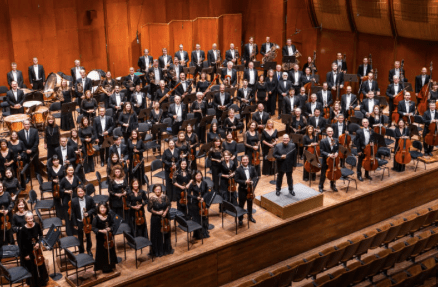
Recently, I was taken to a New York Philharmonic concert by a man I’d never met. (No, not a blind date; more a particularly pleasurable networking opportunity.) Thanks to my new friend, I got my first look at the newly renovated David Geffen Hall, which I had read all about in the pages of OPERA NEWS but had not yet had an opportunity to see with my own eyes. I also got the benefit of my companion’s very knowledgeable commentary about the hall, the orchestra and the music we were hearing. After the concert, I even got to shake the hand of one of the violinists, who happened to be my host’s partner.
On the first half of the program was a brief but electrifying contemporary piece — Fate Now Conquers, by Carlos Simon, who was present to receive the audience’s enthusiastic applause. Beethoven’s Violin Concerto followed, with an astonishingly virtuoso performance by Nikolaj Szeps-Znaider, whose fingers moved with the fleetness of hummingbird wings. Szeps-Znaider then gave us the gift of an unprogrammed encore — a moving rendition of a gently ruminative Bach Sarabande, which in its very short span made as much impact as the featured piece, if not more.
The second half brought Saint-Saëns’s grand-scale “Organ Symphony,” in which the composer, both figuratively and literally, pulls out all the stops. A contingent of more than fifty string instruments and a large phalanx of woodwinds were joined by a long line of trumpets and trombones, a tuba, a piano (four-hand, no less!), triangle, cymbals and of course the organ to fill out the already full sound. Watching the percussionists reawakened my long suppressed urge to play timpani.
What particularly struck me about the Saint-Saëns was the amazing unity of purpose—the greatness that could be achieved by so many individual bodies (and personalities) all bending their efforts toward a single end. If only, in this ever-more-divided world we live in, mankind could work together just as smoothly and selflessly to tackle the monumental challenges we all face.


 Louise T. Guinther
Leave a comment