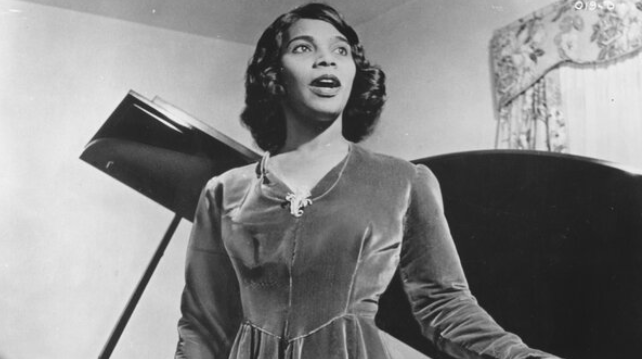
Week 2 of Black History Month brings us to the mezzos and contraltos. As a proud alto myself (choir caliber only), I confess to a particular affection for the lower-voiced ladies, so I’m allowing myself an extra entry in this category, and I’ll break it into two sections, since there is so much to say.
We’ll begin where it all started (at least at the Metropolitan Opera), with the matchless and ground-breaking contralto Marian Anderson. Born and raised in Philadelphia, she gained attention at an early age, singing in choirs in school and at church and earning the nickname “the baby contralto.” After high school, she studied privately, her application to a local music school having been rejected because of her color. With the help of several scholarships, she embarked on a highly successful concert career at home and abroad. At first, she sang largely for black audiences, but her extraordinary voice caught the attention of maestro Arturo Toscanini and impresario Sol Hurok. The latter booked her for New York’s Town Hall and Carnegie Hall and a blockbuster coast-to-coast concert tour.
It was Hurok’s attempt to rent Constitution Hall that led to the famous free concert on the steps of the Lincoln Memorial, attended by some 75,000 people and heard on the radio by millions more. Anderson’s agreement to sing at that concert “did not come easily or quickly,” she said later. “I don’t like a lot of show, and one could not tell in advance what direction the affair would take. I studied my conscience. As I thought further, I could see that my significance as an individual was small in this affair. I had become, whether I liked it or not, a symbol, representing my people.”
When Anderson broke the color barrier at the Met under the leadership of Rudolf Bing, becoming the first black artist to sing as a regular member of the company, she was in the twilight of her career, but her performance as Ulrica in Un Ballo in Maschera was a major statement, signaling a change of attitude at a company that was among the last to engage Black artists in principal roles.
Anderson was a quiet pioneer. On a personal level, she preferred not to make waves when she was treated like a second-class citizen in her native land. In Europe, the finest hotels and restaurants rolled out the red carpet for her, but at home, she was subject to the same degradations as other people of color. She chose to avoid controversy over accommodations and travel by staying with friends, dining alone in her room, and traveling in drawing rooms on night trains. “If I were inclined to be combative, I suppose I might insist on making an issue of these things,” she said. “But that is not my nature, and I always bear in mind that my mission is to leave behind me the kind of impression that will make it easier for those who follow.” On behalf of her audiences, however, she was more outspoken, insisting early on that seats be reserved for Black patrons in all parts of the halls where she sang, and later, as her clout grew, refusing to sing in any venue where audiences were segregated.
Marian Anderson was an American icon, awarded the American Medal of Freedom by Lyndon Johnson and the National Medal of Arts by Ronald Reagan. She will be forever known for her role in the nation’s racial history. But even without that, her voice would be immortal for its own unique magnificence. Its depth and range are astonishing; its timbre is a healing balm. Her lower notes at times could almost be mistaken for a male voice; her upper register has the warm glow of a Raphael halo. Her sound is an immersive experience, both sensual and spiritual—somewhere between a warm hug and a visitation from the divine. Her technique is impeccable, but one isn’t aware of it; when Anderson sings, one hears only an outpouring of emotion. Her legato is a river of liquid gold.
Here she is, first rising above the silliness of the mise-en-scène on the Ed Sullivan show in Schubert’s “Ave Maria,”
and then rising above American racial strife at the Lincoln Memorial with a heartfelt “My Country ’Tis of Thee.” Genius knows no color barriers indeed!
I highly recommend watching the full PBS documentary, Voice of Freedom, for a fuller picture of this towering figure, and prowling Youtube for more examples of her powerful artistry.
https://www.pbs.org/wgbh/americanexperience/films/voice-freedom

 Louise T. Guinther
Leave a comment