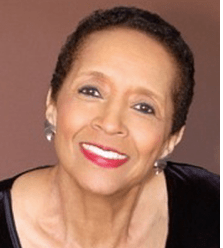
Hilda Harris, a lyric mezzo from Warrenton, North Carolina, began her career as a recording-studio backup singer for the likes of Dionne Warwick, Aretha Franklin and Roberta Flack and juggled classical voice lessons with appearances on Broadway, including 110 in the Shade and Golden Boy. Her opera debut as Cherubino at the Brevard Festival was a succes, and she never looked back. Harris sang roles such as Bizet’s Carmen, Rosina and Dorabella in leading European houses, performed throughout the U.S., at San Francisco Opera, Lyric Opera of Chicago, the Spoleto Festival and other top venues, and made a name for herself at the Met as the first woman of color to sing trouser roles with the company. Harris was in a Met performance of Le Nozze di Figaro that I attended, which featured not one but four great black female singers—Harris as a charmingly vivacious Cherubino with a rich, creamy voice and a strong sense of Mozartean style; the radiant Barbara Hendricks as Susanna; the supremely elegant Roberta Alexander as the Countess; and the dynamic coloratura soprano Harolyn Blackwell as Barbarina.
Harris has also shared her talents as a teacher at Howard University, Sarah Lawrence and the Manhattan School of Music, and as a member of the Black Music Research ensemble, whose mission is to rediscover, preserve and perform music by Black composers. In the following clip, she shows her recital chops, lending her vibrant sound and nuanced interpretive skills to “Oh Black and Unknown Bards,” part of a song cycle written for Harris by the Black composer Dorothy Rudd Moore.
The full text of the poem on which it is based, by James Weldon Johnson (author of “Lift Every Voice and Sing,” known as the “Black National anthem”) can be found here:
https://poets.org/poem/o-black-and-unknown-bards
St. Louis-born mezzo Grace Bumbry became obsessed with classical singing after hearing Marian Anderson in concert as a child. At sixteen, she won a radio competition whose first prize included a scholarship to the St. Louis Institute of Music, but the school did not admit African–Americans, and the radio station instead arranged an appearance on the Arthur Godfrey Talent Scout Show. Her success on the show opened the door to studies at Boston University’s College of Fine Arts. After transferring to Northwestern, she was invited to work with Lotte Lehmann at the Music Academy of the West. Thereafter Bumbry blazed trails as the first Black artist to sing at the Paris Opéra (as Amneris in Aida), the first Black singer in a principal role at Bayreuth (her controversial debut as the “Schwarze Venus” in Tannhäuser) and the first Black opera singer to perform at the White House. She made her Met debut as Princess Eboli in Don Carlo in 1965 and remained with the company through 1986, when she sang Amneris. Ten years later, I had a chance to hear her live in a single aria at the James Levine gala. Some of the bloom was gone from her voice, but the riveting presence was intact.
Bumbry could have been included in Part I of this blog series, since she morphed into a dramatic soprano well into her career, but it is as a mezzo that I remember her best. In this excerpt, with a minimum of physical movement and a maximum of personal magnetism, Bumbry embodies all the elusive insouciance and alluring joi de vivre that draw men to this indelible character at their peril. A slight swagger and a brow raised over those flashing black eyes go farther than all the heavy-handed hip-waggling and vamping that ordinarily creep into this famous number, and the mezzo’s lean, clean sound, attention to stylistic and dynamic niceties, persuasive French and precise, polished diction provide a master class for any would-be Carmen. Best of all, she clearly has a sense of humor about her own irresistibility, which makes her all the more appealing.
Shirley Verrett was born in New Orleans and pursued an opera career over the objections of her strict Seventh Day Adventist parents. Like Bumbry, she appeared on Arthur Godfrey’s show, winning a scholarship to study at Juilliard. In 1961, she won the Met National Council Auditions and made her first appearance on the Met stage singing Carmen’s habanera in the finals concert. Her last performance with the company came nearly thirty years later as Azucena in Il Trovatore. In between she sang more than a dozen other starring roles, both mezzo and soprano. Anthony Tomassini’s obituary in the Times aptly described her as “vocally lustrous and dramatically compelling” and noted that the Milanese press, after her La Scala Lady Macbeths, took to calling her “la Nera Callas.”
Verrett was the first Dalila I ever heard, and she remains the best. Her angular beauty and penetrating tone were ideal in a role that is half sex goddess and half tigress. In some productions, one can’t help wondering how Samson can be so stupid as to fall for Dalila’s tricks, but when the Dalila is Verrett, no one can blame him for letting her wrap him around her little finger. The look on Plácido Domingo’s face after her first few phrases says it all: visually and vocally, Verrett is too divinely sensual to resist.
 Louise T. Guinther
Leave a comment