One of my favorite near-miss stories is that, shortly after my twin sister and I were born, my parents went shopping for a new (larger) apartment and looked at one that was right upstairs, or maybe downstairs, from the apartment of George Shirley. We could have grown up listening through the walls to the warm-up warbling of a Metropolitan Opera great! I wouldn’t have minded living within earshot of either of today’s other two tenor picks either.
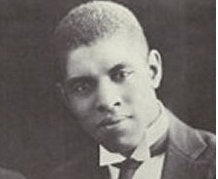
Tenor Roland Hayes was born in 1887 in Curryville, Georgia, to former slaves turned tenant farmers. When his father died, his mother moved the family to Tennessee, where Roland had to leave school after fifth grade to take a job in an iron foundry. Like so many of the black artists we have covered—and those we haven’t—he sang in a choir at the family’s church, where he came in contact with a pianist who introduced him to the records of Enrico Caruso, which, Hayes later said, “opened the heavens for me.” Hayes studied at Fisk University, where he joined the Fisk Jubilee Singers and later toured with them. Told by the manager of the Boston Symphony that a black singer would never be welcomed in the music world, Hayes sought greener pastures in London. His success there led to invitations to perform for royalty, and he made well-received appearances elsewhere in Europe. In Berlin, he overcame a hostile reception, facing a wall of boos before even singing a note, by opening with a rendition of Schubert’s “Du bist die Ruh” that transformed the hisses to a standing ovation. When Hayes returned to the U.S., he was welcomed in venues around the country, eventually including the South, where he sang before an integrated audience in Atlanta. He also sang at Constitution Hall; his demand that the audience be desegregated for his concert was said to have contributed to the subsequent ban on black singers there. Coming full circle, Hayes bought and settled on the land his parents had farmed as tenants in his childhood. He was an inspiration to and supporter of many of the Black singers who came after him, including our next entry. Hayes’s heartfelt approach and expressive use of dynamics and rubato were as effective in the spirituals he grew up with as in the rarefied art songs of Europe.
Here, in the Schubert song that won over that skeptical Berlin audience, Hayes scales back the robust, vibrancy of his timbre to achieve an ethereal delicacy that is a perfect aural representation of amorous rapture. His floated high notes and unwavering legato line are balm for the soul; the gradual ascent on “Dies Augenzelt von deinem Glanz allein erhellt” (The temple of my eye by thy radiance alone is illumined) takes us with him to the brink of paradise.

George Shirley, born in Indianapolis and raised in Detroit, also cut his teeth as a church singer, performing with his parents as a trio, as well as playing baritone horn in a community band. He earned his bachelor’s degree in music education at Wayne State University and made history as the first Black music teacher in Detroit. A year later, he was drafted into the Army and joined the Army Chorus, another first for an African American. It was there that his operatic ambitions were awakened. Following his military service, he returned to his musical studies and won, in short order, a National Arts Club scholarship competition and the Metropolitan Opera Auditions. The latter led to his historic Met debut as Ferrando in Così Fan Tutte— the first time a black tenor had sung a leading role with the company. Shirley sang twenty principal roles there in eleven seasons, ranging from Mozart to Donizetti to Gounod to Verdi. He made a number of important recordings, including one of Così that won him a Grammy Award. In 2015, he was awarded the National Medal of Arts by President Barack Obama. At the end of his performing career, Shirley returned to teaching, as a professor of voice at the University of Maryland and later the University of Michigan. He was quoted in OPERA NEWS as saying that teaching music was like teaching the soul.
Shirley’s virile sound and sensitivity to musical nuance made him an ideal Mozart singer, giving heroic dimension to characters that sometimes come across as wimpy or silly. In Ferrando’s captivating aria “Un aura amorosa,” the sincerity of his delivery, his unimpeachable musicianship and his assured technique contribute to a sense of underlying maturity, making it possible to believe in the happy ending of the opera’s oft-maligned plot.

Kansas City native Vinson Cole started singing early, performing child roles in Tosca and La Bohème at Lyric Opera of Kansas City. At the age of ten, he starred in a production of Amahl and the Night Visitors at his sister’s high school, an experience that awakened dreams of an opera career. After studies at the University of Kansas City and the Curtis Institute of Music and an apprenticeship with Santa Fe Opera, he made a highly successful debut with San Francisco Opera in the title role of L’Amico Fritz. An invitation to Salzburg from Herbert von Karajan jump-started an illustrious career in Europe and began an important working relationship with the conductor. A winner of the Met National Auditions in 1977, Cole had to wait ten years before making his debut with the company, but he sang at the Met regularly thereafter. In recent years, he has taught at his alma maters UMKC and Curtis and at the Cleveland Institute of Music, as well as privately.
In the following clip, Cole sings Don José’s flower song, from Carmen, in a 2008 concert setting. Though his French diction is not perfect, the spirit of his singing is wholly French, with its light yet penetrating tone, its wide and wisely deployed dynamic range and its cleanness of line and attack. Cole was in his late fifties at the time of this recording; it’s a tribute to his technique that his sound retains all of its bright, youthful bloom. Cole creates a sympathetic Don José, projecting tenderness and vulnerability through the sweetness of his timbre and the gentleness of his sustained diminuendos, but there is no mistaking the frisson of sensual yearning and edgy obsession that will eventually lead to his (and Carmen’s) demise.


 Louise T. Guinther
Leave a comment