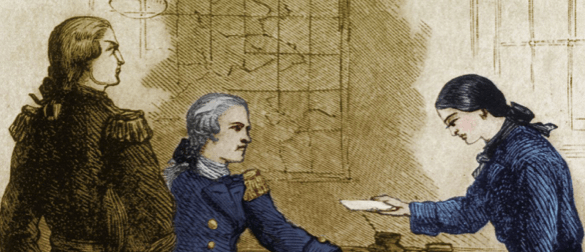
For one of our elementary-school birthdays, my sister and I received a giant coloring book featuring Great Women of American History. I wasn’t much of a feminist in those days, but I was a dyed-in-the-wool tomboy, so while Betsy Ross and Martha Washington were fun enough to color, the image that really caught my imagination was Deborah Sampson, who, I learned from the paragraph below the picture, disguised herself as a man to fight in the Continental Army. The outline showed Sampson in her Revolutionary War uniform, which I carefully colored in blue and white, with some accents of red for patriotic effect—but of course not on the coat!
As I colored, I imagined what courage it must have taken just to attempt such a bold deception—never mind how scary it would have been to actually step onto a battlefield.
As it turns out, Sampson had needed plenty of courage just to make it to twenty-one, the age at which she volunteered. The child of a broken home, abandoned by her father at age five, she lived in poverty with relatives until they were no longer able to afford her care. At ten, she was bound into indentured servitude with the Thomas family, serving them in exchange for food, clothing and shelter. At eighteen she was freed and earned a living as a teacher and weaver. She was also a skilled woodworker, creating sleds, milking stools and weather vanes, among other useful items.
Sampson was twenty-one when she reinvented herself as one Robert Shirtliff and joined the Fourth Massachusetts Regiment. She served for almost a year and a half, from May 1782 to October 1783, in one of the most active troops in the Hudson Valley—the elite Light Infantry, so called because they traveled with minimal kits to be ready for risky missions and skirmishes against Loyalist raiders. One story has it that when she was shot, she removed the bullet herself and continued her duty without proper medical treatment to avoid having her gender discovered. Eventually, however, on assignment in Philadelphia, she contracted a high fever, and the doctor who attended her outed her gently in a letter to General John Paterson, leading to her honorable discharge.
When the war was over, Sampson began a new life, marrying a farmer named Gannett and raising four children (one an adopted orphan). She continued to break ground, successfully petitioning the legislature first for back pay for her Army service, then (with the help of her friend Paul Revere) for a disability pension for her bullet wound. She was the first American woman to give a lecture tour, traveling alone through the Northeast states to talk about her wartime experiences. She began her lectures with an encomium to the traditional role of the woman in the home; she would then return to the stage in uniform and execute a series of difficult military drills.
Though she lived a hardscrabble existence her whole life long, Sampson is proof positive that women don’t have to be confined to any one lifestyle or identity. A woman’s place is wherever she wants it to be. If we have the courage and the determination, we can be and do it all.

 Louise T. Guinther
Leave a comment