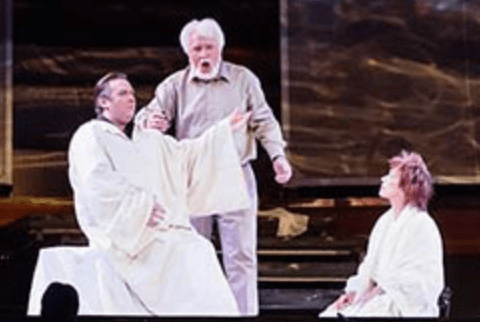
For years, I have driven my family crazy every Good Friday by insisting on listening to Act III of Parsifal in its entirety. I am the only member of our household who really appreciates Wagner’s Bühnenweihfestspiel — a decidedly weird take on some familiar Christian myths, to be sure, but a score filled with music that moves the spirit and touches the soul.
The Good Friday paradox is one aspect of Christianity (possibly the only one) that Wagner gets right. Our hero, Parsifal, after failing to discern his calling in Act I and narrowly escaping the sins of the flesh in Act II, finds his way back, through years of wandering, to the Brotherhood of the Grail, arriving on Good Friday, the day marking Christ’s crucifixion. Parsifal, still stumbling somewhat blindly toward enlightenment and feeling only the tragic implications of Christ’s death, rather than its promise of resurrection, expresses confusion as to why such a sorrowful anniversary should be an occasion for anything but grief and mourning. Gurnemanz responds, in glorious, glowing musical terms, that in the wake of Christ’s sacrifice, the whole world is refreshed and renewed: “It is the tears of repentant sinners that on this day besprinkle field and meadow with holy dew and make them flourish,” he says. “Now all creation rejoices in the Savior’s love.” (In Otto Shenk and Günther Schneider-Siemssen’s wonderfully literal-minded old production at the Met, the stage floor was carpeted with a host of springy little buttercups and daisies that actually bounced back when the performers stepped on them to illustrate Gurnemanz’s explanation that on Good Friday “grasses and flowers in the meadow know that today the foot of man will not tread them down.”)
I can never decide which version of the Karfreitag scene I like the best. In my binge-inclined youth, I used to really try my mother’s patience by putting on all three of my top picks, back to back. The chief criterion for Act III, of course, is not the tenor in the title role but the bass singing Gurnemanz, the wise old knight-of-the-Holy-Grail (not that his wisdom manages to do anybody much good.) When Plácido Domingo first took on the role of Parsifal, he freely confessed that during the Good Friday scene, he could not help wishing he were a bass, so he could sing Gurnemanz’s beautiful lines. Gurnemanz is sort of a combination of narrator and conscience of the story, guiding and advising the other characters while keeping the audience apprised of what is going on.
My favorite exponents of this marathon role are the English bass Robert Lloyd, the German bass Kurt Moll and the New Zealand-born bass-baritone Sir Donald McIntyre. (Yes, Grail Knighthood seems to be a good stepping-stone to the British OBE.) All three have distinctively beautiful voices — Lloyd’s vibrant, penetrating and incisive, Moll’s as plush as velvet and as deep and rolling as the open sea, McIntyre’s gruffer and less smoothly polished than the others, but dark, authoritative and singularly expressive.
Their characterizations too are equally compelling and decidedly different. Moll is the most fatherly and the most composed, projecting beneficence along with patience and hard-won perspective. Lloyd is protective and professorial—at once a caring mentor and a fellow seeker. McIntyre, one of the most economical and powerful actors I have ever seen, is the most empathetic and the most fully human. (When he sang the opera’s villain, Klingsor, earlier in his career, John Freeman wrote in OPERA NEWS that McIntyre’s rendition of the malevolent magician was “more fallen angel than driven fiend.”) McIntyre’s Gurnemanz seems to live all the roles at once in his tender, deeply felt account of Karfreitag’s Zauber (Good Friday’s magic) — not only his own experience as compassionate observer but Amfortas’s as suffering sinner, Parsifal’s as pure fool in pursuit of wisdom and even Jesus’s as sacrificial redeemer—so that when he describes nature “absolved from sin, gaining its day of innocence.” it seems to be his own trials and sufferings that have been translated into Easter joy.
 Louise T. Guinther
Leave a comment