According to FOX, Saturday night is “Baseball Night in America.” That may be a catchy title, but if you’re a baseball fan, you know that every night is baseball night in America — at least every night from the beginning of April through the end of October. That’s one of the great beauties of the sport: if a game doesn’t go your way, you don’t have to wait a week or even a few days for redemption. You know you get another chance tomorrow! By the same token, you can’t get too excited about any victory, no matter how impressive, since the high can only last until the next first pitch, which is usually the very next day. Being a baseball fan isn’t an occasional thing — it’s a full-time commitment.
The sports pundits tell us that baseball has lost some of its swat in recent years. Football offers more blood and guts. On the amateur level, everyone’s a soccer mom nowadays. Even cricket, that incomprehensible second cousin of our national pastime, has been reaching across the pond lately to try to horn in on the action. Some sportswriters have actually argued that baseball isn’t really the American national pastime any more—that other sports have displaced it in the nation’s consciousness—and that’s a shame.
Baseball is a great game, a great tradition, a great connection across generations. Baseball is majestic, it’s athletic, it’s strategic, it’s mesmeric, it’s democratic. At a baseball game, you can see everything you need to see, even from the crummy seats. The bottom of the lineup can be just as important as the top. Of course everyone loves a pitching staff full of aces and a batting order like Murderer’s Row. But baseball is a marathon. You can’t win a season without the long relievers and the utility players, and even the little guy in the ninth spot can dream of getting the game-winning hit.
Baseball is beautiful: no other sports arena can compare with the green glory of a baseball diamond. It’s also peaceful (at least it used to be before the big-league teams started playing irrelevant pop songs at deafening levels between innings and sometimes even pitches). There’s a calming rhythm to the game and a delightful music to the roar of the crowd and the crack of the bat.
Baseball requires concentration and repays dedication. You can get the hang of its basics well enough to enjoy it right away, but it takes years to get handle on all its nuances. The more you know about the fine points of the game, the more endlessly fascinating it is to watch. I’ve heard it said that baseball is boring, but that’s only true if you don’t really know what you’re looking at. Baseball is a world in which the runners and the ball move fast, but everything else takes time. In between the home runs, stolen bases and strikeouts that any newbie can appreciate, the connoisseur can absorb the subtle changes in the way each fielder plays a particular batter; the unique communication between pitcher and catcher; the fascinating instinct that allows a great fielder to get a jump on a ball almost before it’s hit; the mind games that go on between baserunners and pitchers; the complexities of deciding on pinch-hitters and defensive replacements. The possibilities are endless.
Best of all, baseball is infinite —theoretically at least — because it isn’t timed. Yogi Berra’s famous remark that “It ain’t over ’til it’s over” captures the essence of its beauty. If the game ain’t over ’til it’s over, then hope really can spring eternal. I’ve never understood why anyone would leave a baseball game early. In football, soccer, basketball, hockey, there comes that inevitable and deflating point where no matter what the team that is trailing does, it cannot hope to make up the difference. In baseball, anything can happen right down to the last out.
The real problem isn’t that baseball is boring, it’s that America has ADD. In recent years, the powers-that-be have been messing around with the rules of the game to make it move faster, as if the goal were to get it over with. A ballgame is supposed to take up the whole afternoon or evening — or both. A doubleheader used to be one of the supreme inventions of the human race — a chance to settle in and devote an entire day to the delightful and innocent pursuit of watching baseball. A whole day in which kids couldn’t get into trouble and grownups got to take a mental break from the woes of the real world. Why would anyone want to get that over with?
I can’t help laughing when sportscasters talk seriously about who’s in first place before the All-Star Break. The modern obsession with predictions and standings doesn’t make sense in a sport that has 160 regular-season games. Each baseball game is its own treasure, whether the teams playing are in first place or in last. The philosophy of baseball has more to do with the words of the immortal Harry Chapin: “It’s gotta be the going, not the getting there that’s good.”
For a slice of nostalgia from the days when Americans—especially Brooklynites—lived and died baseball, I offer this Dodger-fan fantasia, starring the great American baritone Robert Merrill, who dreamed of playing pro ball before plumping for the opera stage.
https://www.youtube.com/watch?v=YtKSEVC_2d0
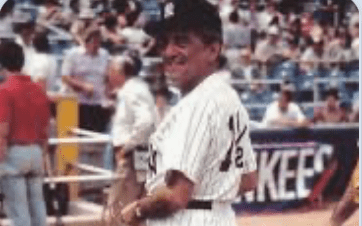
Merrill played both sides in the Dodgers–Yankees rivalry. After recording the Brooklyn Baseball Cantata, he had a regular gig singing the National Anthem for the Yankees in the Bronx — for which he often wore his Yankee uniform, emblazoned with the number 1 1/2. George Steinbrenner, who had many faults, had one good quality: he recognized Merrill’s rendition of the anthem as the best in the world, and Merrill’s voice, in person or on record, began the vast majority of Yankee games during the Steinbrenner regime.

 Louise T. Guinther
Leave a comment