Christmas is less than a week away, and the sounds of the season are everywhere. I have already been caroling once and plan to go again. However, until this Sunday, it is technically still Advent, which, for me, brings its own auditory joys.
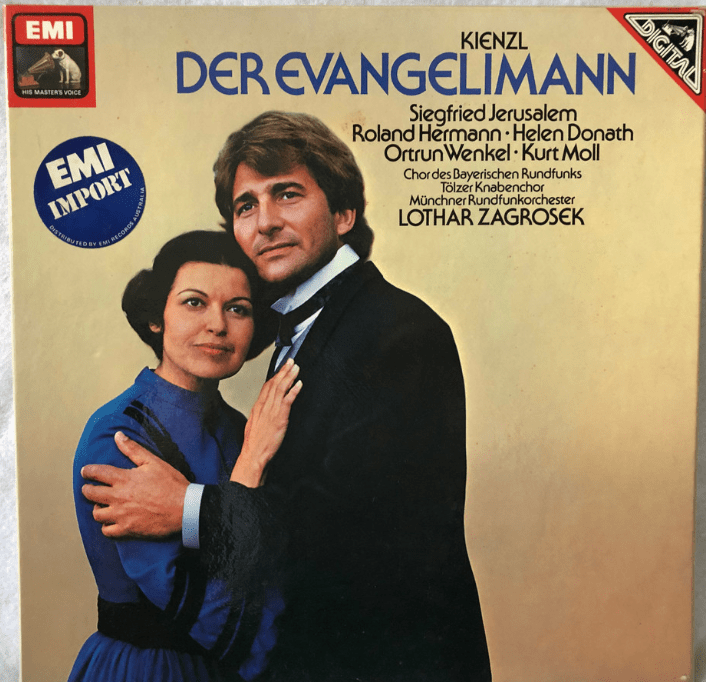
One of my personal musical traditions in Advent is listening at least once to Wilhelm Kienzl’s deeply Christian Der Evangelimann, an under-appreciated opera that tells of Matthias, a young man whose hateful and envious brother deprives him of love and liberty by setting a fatal fire and framing him. While Matthias is in jail, the woman both brothers love throws herself into the river and drowns.
Despite this grim setup, the story carries a strong and cathartic message of Christian perseverance, transformation and reconciliation. After serving his term, Matthias emerges from twenty years’ hard labor (schwerer kerkerhaft is one of my favorite terms)—and subsequent ostracism and poverty—as an itinerant preacher, showing others the path to God. (John the Baptist, anyone?) Summoned to hear the confession of a dying man, Matthias is thunderstruck to recognize his brother, who is equally horrified by the encounter with the man he has wronged. At first, Matthias recoils from his tormentor, but he is almost instantly moved to forgive and bless his brother, who dies in the knowledge that he has been freed from his debt, on earth as in heaven.
It’s a perfect Advent story, a tale of long waiting for redemption, of hope that wavers but doesn’t die, of love strong enough to blot out sins and overcome the sharpness of death. Kienzl’s score is widely varied in tone, from almost operetta-like lightness to Wagnerian sturm und drang. Matthias’s music in the latter section, after he has turned evangelist, has a gentle, contemplative quality that seems suitable to a season of self-examination and openness to the divine. And the voice of Siegfried Jerusalem as our hero (on an EMI recording that also features the heavenly Helen Donath and the matchless Kurt Moll) has an innocence, a straightforward earnestness and a natural sheen that conveys unassailable faith.
My favorite moment, especially during Advent, is “Selig sind,” a glorious setting of several verses of the Beatitudes (the ones about those who are persecuted for righteousness sake*) that goes straight to the heart. In a scene of exquisite simplicity, Matthias teaches the text to the village children, who sing it back to him responsively. Jerusalem’s lustrous tenor glows with sincerity and warmth in Kienzl’s soaring melodies, and his brave, heartfelt, utterly uninhibited performance makes the transcendent moment of forgiveness perfectly believable and deeply moving.
I urge you to delve into the whole opera, which will reward you for your time and attention. Meanwhile, just for fun, check out a quite different version by Plácido Domingo, with an admirable contribution from that inimitable holiday institution, the Vienna Choir Boys.
*Blessed are they which are persecuted for righteousness’ sake: for theirs is the kingdom of heaven.
 Louise T. Guinther
Leave a comment