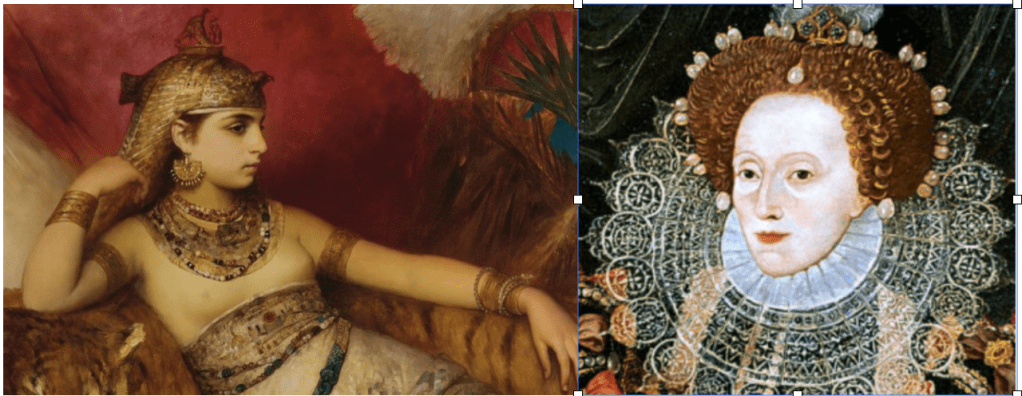
Before women’s history month is over, I thought it would be fun to consider a couple of women who shattered the glass ceiling in spectacular fashion long before women’s rights were even a thing. Cleopatra, the fabled Queen of the Nile, reigned in Egypt with a succession of co-rulers but came away with the lion’s share of the fame. Queen Elizabeth ruled over a period of glorious prosperity. Both have been honored with multiple operas telling, with varying degrees of historical accuracy, of their lives and exploits.
In fairness, the glass ceiling comment doesn’t apply so much to the Ancient Egyptians, who apparently had fewer hangups about letting a woman be in charge than many other cultures, then or now. The likes of Nefertiti (who, with her husband, Akhenaten, championed monotheism before King Tut came along to restore the old order) and Hatshepsut (only the second female pharaoh in Egyptian history, and one of the most successful) had already held the throne before Cleopatra came along. In the biography of the Emperor Augustus, Cleopatra was unfairly cast as “an immoral foreign woman who tempted upright Roman men,” according to the Encyclopedia Brittanica. But the image of her that stuck was the much more favorable and sympathetic portrait created by William Shakespeare in Antony and Cleopatra, who gives Enobarbus the indelible line, “Age could not wither her, nor custom stale her infinite variety.”
Georg Frideric Handel further glamorized her in his brilliant, prototypically baroque opera, which contains an “infinite variety” of its own, with almost tongue-in-cheek episodes alongside more serious moments, such as this reflection from Act III, sung by the inimitable Kathleen Battle:
Recitativeo
E pur così in un giorno
perdo fasti, e grandezze? Ahi fato rio!
Cesare il mio bel nume è forse estinto;
Cornelia, e Sesto inermi son, né sanno
darmi soccorso. O dio!
Non resta alcuna speme al viver mio.

Aria
Piangerò la sorte mia
sì crudele e tanto ria
finché vita in petto avrò.

Ma poi morta d'ogn'intorno
il tiranno e notte e giorno
fatta spettro agiterò.
Recitative
And thus in a single day
I lose all pomp and grandeur? Ah perfidious fate!
Caesar, my handsome god, is perhaps dead;
Cornelia and Sesto are powerless and
know not how to help me. O god!
No hope remains in my life.

Aria
I shall weep over my fate,
So cruel and so perfidious
so long there is life in my breast.

But once I have perished, from every corner,
night and day, my ghostly spirit
will torment the tyrant.
Shakespeare was also the inspiration for one of the most infamous fiascos in Metropolitan Opera history, the world premiere of Samuel Barber’s Antony and Cleopatra, which flopped despite the presence of Leontyne Price in the title role. Franco Zeffirelli’s over-the-top production, which managed to dwarf even the larger-than-life Price, was largely responsible, but it’s worth a look back at Cleopatra’s death scene, which is suitably monumental for an icon playing an icon.
https://www.youtube.com/watch?v=hU0AuBdQJp8
Cleopatra
Give me my robe, put on my crown; I have
Yare, yare, good Iras; quick. Methinks I hear
Antony call; I see him rouse himself
To praise my noble act; I hear him mock
The luck of Caesar, which the gods give men
To excuse their after wrath: husband, I come:
Now to that name my courage prove my title!
I am fire and air; my other elements
I give to baser life. So; have you done?
Come then, and take the last warmth of my lips.
Farewell, kind Charmian; Iras, long farewell.
[Kisses them. IRAS falls and dies]
Have I the aspic in my lips? Dost fall?
If thou and nature can so gently part,
The stroke of death is as a lover’s pinch,
Which hurts, and is desired. Dost thou lie still?
If thus thou vanishest, thou tell’st the world
It is not worth leave-taking.
Charmian.
Dissolve, thick cloud, and rain; that I may say,
The gods themselves do weep!
Cleopatra.
This proves me base:
If she first meet the curled Antony,
He’ll make demand of her, and spend that kiss
Which is my heaven to have. Come, thou
mortal wretch,
[To an asp, which she applies to her breast]
With thy sharp teeth this knot intrinsicate
Of life at once untie: poor venomous fool
Be angry, and dispatch. O, couldst thou speak,
That I might hear thee call great Caesar ass
Unpolicied!
Charmian.
O eastern star!
Cleopatra.
Peace, peace!
Dost thou not see my baby at my breast,
That sucks the nurse asleep?
Charmian.
O, break! O, break!
Cleopatra.
As sweet as balm, as soft as air, as gentle, —
O Antony! — Nay, I will take thee too.
[Applying another asp to her arm]
What should I stay —
[Dies]
The Met will be hosting yet another operatic take on the Queen of the Nile this spring when it presents the company premiere of John Adams’s Antony and Cleopatra. Here is a teaser from the San Francisco production, starring Amina Idris, to get you in the mood.
CLEOPATRA
    I [dream'd]1 there was an Emperor Antony:
    O, such another sleep, that I might see
    But such another man!

DOLABELLA
    If it might please ye,--

CLEOPATRA
    [His face was as the heavens; and therein stuck
    A sun and moon, which kept their course, and lighted
    The little O, the earth.]2

Queen Elizabeth had a scrappy road to the throne. Her father not only had her mother beheaded but persuaded parliament to declare the marriage invalid, rendering Elizabeth "illegitimate" and removing her from the line of succession. (She was restored to it after her half-brother Edward was born.) Nevertheless, she was educated with the same rigor as the male members of the family. Her tutor Roger Ascham paid her one of history's best backhanded compliments: “Her mind has no womanly weakness,” he wrote, and “her perseverance is equal to that of a man." (She, on the other hand, once declared, in a speech to her troops, "“I know I have the body of a weak and feeble woman, but I have the heart and stomach of a king, and of a king of England too.”) At any rate, she was more than ready when, after the brief reigns of Edward VI and Mary I, the death of the latter gave Elizabeth her turn.

Elizabeth made the most of her opportunity, defying the era's misogynistic theory that women were unfit to govern. During her rule, England established a strong influence in politics, commerce and the arts. According to the Encyclopedia Brittanica, "Elizabeth’s blend of shrewdness, courage, and majestic self-display inspired ardent expressions of loyalty and helped unify the nation against foreign enemies." By any measure, the Elizabethan Age was a golden one.

Elizabeth was treated less kindly than Cleopatra by her operatic biographers, who couldn't resist focusing on her romantic life, in which she was decidedly less decisive and victorious. In Elisabetta, Regina d'Inghilterra,  Rossini's take on Elizabeths's romantic attraction to the Earl of Leicester, the title character is cruel and manipulative, threatening to have both her favorite and his wife executed, until the final scene, in which she  overcomes her jealousy and handsomely relents — never more handsomely than in this rendition by Montserrat Caballé.
Elisabetta: Bell’alme generose,
a questo sen venite.
Vivete, omai gioite;
siate felici ognor.
(Dopo aver abbracciato Matilde ed Enrico, li fa avvicinar a Leicester.)
Matilde, Leicester, Enrico e Guglielmo:
Oh grande!
Elisabetta:
Sorgete.
Coro (di dentro):
Leicester!…
Elisabetta, Matilde, Leicester,
Enrico e Guglielmo:
Quai grida!
Coro:
Vederlo vogliamo.
Morire al suo piè.
In Benjamin Britten’s Gloriana, Elizabeth I is again depicted as petty and jealous. Her best moment is the Soliloquy and Prayer in which, torn between love and duty, she implores God for the strength and grace to fulfill her royal calling.
Donizetti’s Roberto Devereux and Maria Stuarda again focus on the Virgin Queen’s jealousy and self-interest. In the former, infuriated at learning that he is in love with another woman, she wavers between allowing him to be executed for treason and using her power to save him. As usual, the Queen’s strength and political prowess get short shrift, and her thwarted passions take center stage. From a musical standpoint, however, Donizetti does the soprano playing this role full justice. In this clip, the recipient of his bounty is the ever-glorious Beverly Sills.
https://www.youtube.com/watch?v=G_YXP6iOa38
ELISABETTA
Il core togliermi di Roberto! …
Pari colpa sana togliermi il serto.
un momento di silenzio: ella si calma alquanto
L’amor suo mi fe’ beata,
Mi sembrò del cielo un dono …
E a quest’alma innamorata
Era un ben maggior del trono.
Ah! se fui, se fui tradita,
Se quel cor più mio non è,
Le delizie della vita
Lutto e pianto son per me!
ELIZABETH
To take Robert’s heart from me!
A blow as sharp as taking away my crown.
a moment of silence: she calms down somewhat
His love has blessed me,
It seemed to me a gift from heaven …
And to this enamored soul
It was a treasure greater than the throne.
Ah! if I was, if I was betrayed,
If that hear is no longer mine,
The delights of life
Mourning and crying are for me!
Maria Stuarda gives us Elizabeth yet again in the grip of an unbecoming passion, in this case her hatred of her potential rival, Mary Queen of Scots. While this fictional scene of confrontation does not present us with a poised and charismatic monarch, it does give us one of the most brilliantly built scenes of musical vituperation in the history of the art form, culminating in Maria’s ultimate insult, “Vil bastarda!” — an expression of the Catholic Church’s opinion that Henry’s second marriage, to Elizabeth’s mother, Anne Boleyn, never counted, since the Pope had never granted an annulment of his first. Nobody has embodied the rising pride and fury of this scene like the ever committed, never inhibited Shirley Verrett (Elisabetta) and Leyla Gencer (Maria Stuarda).
https://www.youtube.com/watch?v=006NiekSouI
MARIA (va ritrosa ad inginocchiarsi innanzi ad Elisabetta)
Morta al mondo, e morta al trono,
Al tuo piè son io prostrata.
Solo imploro il tuo perdono:
Non mostrarti inesorata.
Ah! sorella, omai ti basti,
Quanto oltraggio a me recasti!
Deh! solleva un’infelice
Che riposa sul tuo cor.
CECIL (ad Elisabetta)
Non dar fè, te ne scongiuro,
A quel labbro mentitor.
ELISABETTA (a Maria)
No, quel loco a te si addice;
Nella polvere e nel rossor.
MARIA
(Sofferenza.)
(ad Elisabetta)
E a me si fiera
Chi ti rende?
ELISABETTA
Chi? Tu stessa;
L’alma tua, quell’alma altera,
Vile, iniqua …
MARIA
(E il soffrirò? e il soffrirò?)
ELISABETTA
Va, lo chiedi, o sciagurata,
Al tuo talamo tradito,
Ed all’ombra invendicata
Di quel misero marito;
Al tuo braccio, all’empio core
Che tra’ vezzi dell’amore
Sol delitti e tradimenti,
Solo insidie macchinò.
MARIA (a Leicester)
Ah! Roberto!
Più resistere non so.
LEICESTER (a Maria)
O Dio! che tenti?
CECIL (ad Elisabetta)
Ah! non dar fè, te ne scongiuro
A quel labbro mentitor.
LEICESTER (a Maria)
Chiama in sen la tua constanza!
Qualche speme ancor ti avanza.
Non ti costi onore e vita
Una grazia a te impartita,
Un favor che al nostro affetto
Tante volte il ciel negò.
ELISABETTA
Quali accenti al mio cospetto!
Parla, o Conte.
LEICESTER
E che dirò?
ELISABETTA
Ov’è mai di amor l’incanto,
E quel volto amabil tanto?
Se a lodarlo ognun si accese
A favori un premio rese;
Ma sul capo di Stuarda
Onta eterna ripiombò.
MARIA
Ah, che sento!
Più resistere non so.
Ah! Roberto!
Più resistere non so!
LEICESTER
O Dio, ti frena!
MARIA
Quale insulto!
O ria beffarda!
ELISABETTA (a Maria)
Quali accenti! Trema, trema!
ANNA, LEICESTER, TALBOT (a Maria)
Che favelli! Taci, deh! taci!
CECIL (a Maria)
Trema, trema!
MARIA
Ah! no, no!
Figlia impura di Bolena,
Parli tu di disonore?
Meretrice indegna e oscena,
In te cada il mio rossore.
Profanato è il soglio inglese,
Vil bastarda, dal tuo piè!
ELISABETTA
Guardie, olà!
(Entrano i soldati.)
ANNA, LEICESTER, TALBOT
Quali accenti! Ella delira!
Giusto ciel! Perduta ell’è!
CECIL, CORTIGIANI
Quali accenti! Ella delira!
Speme più per lei non v’è!
N 11: Stretta finale
ELISABETTA (a Maria)
Va, preparati, furente,
A soffrir l’estremo fato:
Sul tuo capo abbominato
La vergogna spergerò.
(alle guardie)
Trascinate la furente
Che se stessa condannò!
CECIL
Dell’audace il ciel possente
La vendetta omai segnò!
MARIA
Grazie, o cielo! Alfin respiro.
Dai miei sguardi ell’è fuggita.
Al mio piè restò avvilita,
La sua luce si oscurò!
ANNA, TALBOT
Quali accenti! Sventurata!
Tu offendesti Elisabetta!
Forse, ah, forse la vendetta
All’offesa destinò (preparò)!
LEICESTER
Ah! ti perdo, o sconsigliata,
Quando salvarti bramai.
Quando fido a te tornai
Il destin ci fulminò.
CORTIGIANI
Dal supplizio l’onta estrema
La Regina a te serbò.
Sì, taci, vieni, trema, trema,
Ogni speme si ecclissò.
TALBOT (a Leicester)
Leicester vieni,
Non ti senta Elisabetta.
MARIA, LEICESTER
Addio! Per sempre!
ANNA
Deh taci! Ah, vieni!
ELISABETTA (alle guardie)
Olà! … Trascinatela!
(Le guardie si avanzano per trascinare Maria.)
ELISABETTA (a Maria)
Nella scure che ti aspetta
Troverai la mia vendetta.
(alle guardie)
Transcinate la furente
Che se stessa condannò.
MARIA (Vedendo circondata dalle guardie, ripiglia con entusiasmo crescente.)
Or guidatemi alla morte:
Sfiderò l’estrema sorte.
Di trionfo un sol momento
Ogni affanno compensò.
LEICESTER
Ah! ti perdo sconsigliata, ecc
Quando fido a te tornai
Il destin ci fulminò.
Per sempre ci lasciò.
ANNA, TALBOT
Quali accenti! Sventurata! ecc
Ah! qual dai tormeti
A chi salva ti bramò.
CORTIGIANI
Del supplizio l’onta estrema, ecc
CECIL
Dell’audace il Ciel possente
La vendetta omai segnò.
MARIA (va ritrosa ad inginocchiarsi innanzi ad Elisabetta)
Dead to the world and dead to the throne,
At your feet I prostrate myself.
I only implore your pardon:
Be not inexorable.
Ah, sister, let it be enough for you,
the outrages I have already suffered!
Raise up an unhappy woman, who rests against your heart.
CECIL (ad Elisabetta)
Don’t place your faith, I beg you,
In these lying lips.
ELISABETTA (a Maria)
No, that is where you belong;
In the dust, and in shame.
MARIA
(Oh anguish!)
(ad Elisabetta)
Who has made you
so proud to me?
ELISABETTA
Who? Yourself;
Your soul, that high and mighty soul,
Wicked woman …
MARIA
(And must I suffer it?)
ELISABETTA
Go, wretched one,
Ask your betrayed marriage bed,
and the unvindicated shade
Of that miserable husband of yours;
ask your arms, your impious heart
That amid the charms of love
Only wickedness and betrayal,
only traps you laid.
MARIA (a Leicester)
Ah! Roberto!
I can bear it no longer.
LEICESTER (a Maria)
O God! what are you thinking?
CECIL (ad Elisabetta)
Ah! Place no faith, I beg you, in these lying lips.
LEICESTER (a Maria)
Summon your constancy to your heart!
Some hope yet remains.
Don’t let it cost you honor and life
A gift imparted to you,
A favor that to our desires
Is often denied by heaven.
ELISABETTA
What accents in my presence!
Speak, oh Count.
LEICESTER
And what shall I say?
ELISABETTA
Where now is the enchantment of love?
And that face so adorable?
On the head of Stuart
Eternal shame has fallen.
MARIA
Ah, What do I hear!
I can bear no more.
Ah! Roberto!
I can bear no more!
LEICESTER
O God, contain yourself!
MARIA
What an insult!
O such mocking!
ELISABETTA (a Maria)
What a tone! Tremble, tremble!
ANNA, LEICESTER, TALBOT (a Maria)
What are you saying! Quiet!
CECIL (a Maria)
Tremble, tremble!
MARIA
Ah! no, no!
Impure daughter of Boleyn,
Speak you of dishonor?
Harlot unworthy and obscene,
On you my blushes fall.
The English soil is profaned,
vile bastard, by your foot!
ELISABETTA
Guards!
(Entrano i soldati.)
ANNA, LEICESTER, TALBOT
What a tirade! She’s out of her mind.
Just heaven! She is lost!
CECIL, CORTIGIANI
What a tirade! She’s out of her mind!
There is no hope left for her!
N 11: Stretta finale
ELISABETTA (a Maria)
Go, prepare, madwoman,
To suffer the extreme fate:
Upon your abominable head
Shame will fall.
(alle guardie)
Take away the madwoman
Who is condemned from her own mouth!
CECIL
Against the haughty, mighty heaven
Has signaled its vengeance!
MARIA
Thanks, Oh heaven. I breathe at last.
She has gone from my sight.
At my feet she was rejected,
Her light was cast into shadow!
ANNA, TALBOT
What words! Unfortunate one!
You offended Elisabetta!
Perhaps even now, revenge is being
Plotted for the offense!
LEICESTER
Ah, I have lost you, unwise one,
When I wished to save you.
When I returned to you faithfully,
Destiny has struck us.
CORTIGIANI
The queen has reserved for you
The ultimate shame.
Yes, be silent, come and tremble,
Your hopes are all eclipsed.
TALBOT (a Leicester)
Leicester come,
Don’t you hear Elisabetta.
MARIA, LEICESTER
Farewell forever!
ANNA
Be quiet! Ah, come!
ELISABETTA (alle guardie)
You there! Bring her along!
(Le guardie si avanzano per trascinare Maria.)
ELISABETTA (a Maria)
On the scaffold that awaits you
You will find my vendetta.
(alle guardie)
Bring the madwoman
Who has pronounced her own doom.
MARIA (Vedendo circondata dalle guardie, ripiglia con entusiasmo crescente.)
Now lead me to death.
I will defy my fate.
One moment of triumph
Will compensate all griefs.
Of course, all these scenes make for great opera, but in honor of Women’s History Month, I’d like to propose a new Elizabeth opera — one that takes as its starting point the self-confident, powerful, charismatic woman whose immortal pearls of wisdom included, “Life is for living and working at. If you find anything or anybody a bore, the fault is in yourself”; “A clear and innocent conscience fears nothing”; and my personal favorite, “Grief never ends, but it changes. It is a passage, not a place to stay. Grief is not a sign of weakness nor a lack of faith: it is the price of love.”
 Louise T. Guinther
Leave a comment