My favorite radio station, WQXR, spent much of today playing listeners’ requests for music that was in some way connected with their fathers. It was rather a sweet idea, even if it yielded a lot of very well-worn chestnuts such as Bolero and the New World Symphony. It seemed a nice way to honor the paternal influence, and of course, hearing about the musical tastes of other people’s fathers reminded me of my own.
My daddy was a man of wide-ranging interests and multifarious talents. His creativity and intrepidity knew no bounds. He took us to ballgames, beaches and Broadway; he introduced us to choirs, community theater and cooking out; he built us sawhorses, a zoo and the world’s best dollhouse; he passed on his very minimal skills at golf and fishing, and he was as happy figuring out how to pour cement and lay bricks (for a shed that still stands today, some half century after it was built) as he was delving into a musical score with the St. Luke’s Choir or the Forest Hills Friends of Music.
Dad exposed us to cultural influences of all sorts — museums, botanical gardens, piano and ballet lessons, classical concerts at Carnegie Hall and Great American Songbook musicales around the piano in our living room. His own musical enthusiasm was sparked early on, in the good old days when music education was an automatic part of a young boy’s growing up. To help him and his classmates recognize the greats of the classical literature, his teacher taught him such indelible ditties as “Papa Haydn’s dead and gone/ but his memory lingers on./ When his mood was one of bliss/ he wrote cheerful tunes like this!”
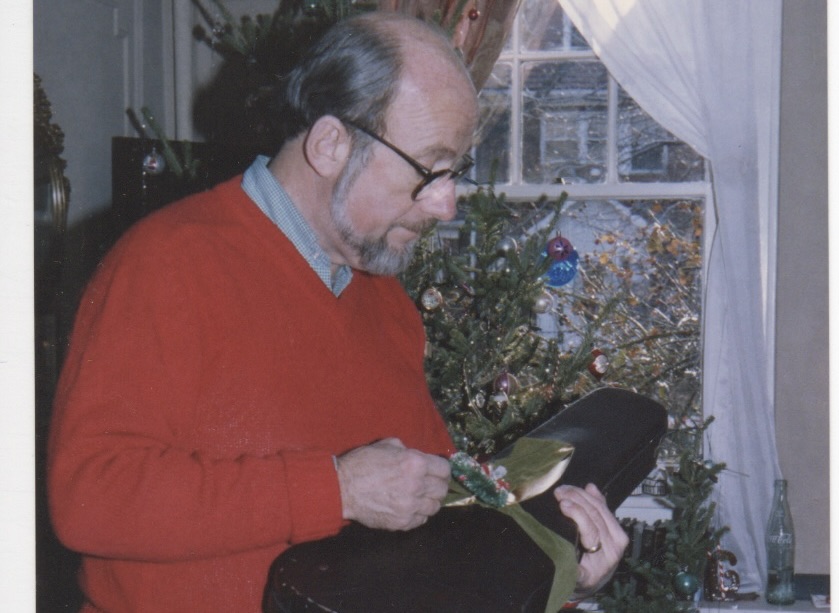
Dad’s elementary school even had an orchestra, in which he played the violin. He kept on playing right through high school, and decades later, when the mood took him, he would bring out the old fiddle and play Christmas carols, or any pretty tune that was in season. Sometimes Mom would sit down at the piano as Dad sawed away, and my sister and I would sing along.
One of the pieces he remembered fondly from his youth was the overture to Alessandro Stradella, a romantic opera by Friedrich von Flotow (of Martha fame) based on the real-life baroque composer. (The plot of the opera is only very loosely based on the historic Stradella, a womanizer whose colorful life eventually ended at the hands of the enraged family of one of his mistresses. In the opera, Stradella’s musical talents melt the hearts of his would-be assassins, and he lives on and gets the girl in the end.)
Dad didn’t know any of this: he only knew the overture, and I remember searching, for several Father’s Days in a row, for a recording of it. At the time, no one had thought up Spotify or Youtube, and one had to haunt Tower Records daily during one’s lunch hour to see what new obscure compilations had turned up in the classical bins. Dad was notoriously difficult to shop for, so I was very pleased with myself when I finally found a copy, and Dad was pleased with me too. In retrospect, I’m grateful for the introduction to this piece, which, despite its lilting melodies and characterful changes of mood, doesn’t get a whole lot of air time these days.
Dad’s big musical obsession was Gilbert & Sullivan. He seemed to know all the words to everything in the Savoyard canon. I memorized most of The Pirates of Penzance when Kevin Kline played the Pirate King, but Dad knew practically every line in Iolanthe, Patience, The Sorcerer and even Cox & Box. He had all the Isidore Godfrey recordings and was particularly partial to the chorus of dead ancestors in Ruddigore. If you’re ever looking for a good insult, look no further than this handy list:
“Coward, poltroon, shaker, squeamer,
Blockhead, sluggard, dullard, dreamer,
Shirker, shuffler, crawler, creeper,
Sniffler, snuffler, wailer, weeper,
Earthworm, maggot, tadpole, weevil!”
In a somewhat more serious vein, Dad was a big fan of Risë Stevens’s Carmen and had an ancient copy of her Columbia Masterworks Carmen album autographed “To Fred.” During our years of opera-going together, he saw many other Carmens and was always generously admiring of their talents, but nobody held a candle to Risë. She was just so insouciantly gypsy. (It didn’t hurt that her José was the elegant and idiomatic Raoul Jobin.)
Dad was also an early and ardent admirer of Candide, which he continued to love through its many revivals and revisions. But there was really only one Cunegonde, the incomparable Barbara Cook, whom Dad later adored all over again in She Loves Me and The Music Man. In Candide, Cook knocked everybody’s socks off with “Glitter and Be Gay,” but the most touching moment is the finale, in which Cook’s absolutely pure and crystal-clear sound magnificently embodied the sincerity of the central characters’ reconciliation with each other and with the world. The Candide, of course, is Robert Rounseville, of whom Dad was also a devoted fan.
Last but not least, there was the Father’s Day anthem. Some time during his Army days, Dad had seen a wonderful German musical called Das Feuerwerk, with lovely operetta-like music and an enchanting circus theme. He always dreamt of putting it on in our local community theater, but he never found an English translation; the only part of it that ever made it into the American consciousness was the Eddie Fischer hit “Oh my Papa.” While we have nothing against Eddie Fischer, the version we played for Dad every Father’s Day without fail was the original-cast album, auf Deutsch. O mein papa war eine schöne Mann — eine schöne Mann indeed!


 Louise T. Guinther
Leave a comment