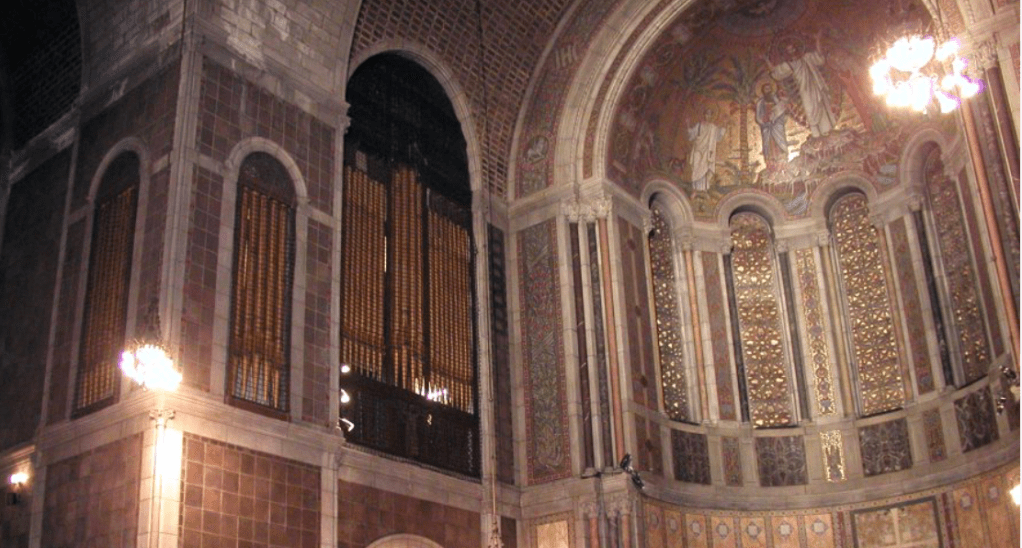
There’s something eminently civilized about an organ recital, which can be tremendously comforting at a time when civilization — or at least my idea of it — seems to be crumbling beneath our feet. The big, beautiful sacred space, the anticipatory hush between pieces, the ebb and swell of that overwhelming sound somehow remind us that there is something bigger than ourselves if we can only listen for it together. The organ music of Johann Sebastian Bach — the all-time master of the genre, whose birthday was yesterday — has a certain gravitas, a sense of orderliness that seems to ground the whole musical world and, by extension, the world of anyone who hears it.
The instrument itself, a vast array of pipes of various lengths and widths, often scattered throughout the building that houses it, produces a myriad of sounds as diverse as a full orchestra, all controlled from a compact console, wildly elaborate but meticulously organized, and operated by a single human being, whose highly trained hands and feet command multiple keyboards, a bouquet of stops and a dance-floor of pedals. Surely the people who invented, compose for and play this astonishing machine can only have been created and inspired by a loving God who wouldn’t think of letting His creation destroy itself as, lately, we seem so determined to do.
This afternoon, Paolo Bordignon, the brilliant and indefatigable organist at St. Bartholomew’s Church on Park Avenue, offered just such a masterfully civilized recital. (According to a program note, the St. Bart’s organ he was playing with such apparent ease comprises 168 stops, 225 ranks and 12,422 pipes, but who’s counting?) The four pieces lasted only about three quarters of an hour, but it was enough to press an inner reset button and give me a fresh perspective on the week ahead. To anyone who had the misfortune of missing it, I offerd the consolation of Dr. Bordignon’s recording of Bach’s “Little” Fugue in G Minor.
https://www.youtube.com/watch?v=BUrFLVdd89A&list=RDBUrFLVdd89A&start_radio=1
If you are based in New York, I also advise you to look into the wonderful musical offerings regularly available at St. Bart’s — some of them free! They will calm you and center you in a way that another afternoon in front of the TV or computer screen could never do. You can find information on this season’s remaining programs at https://www.mmpaf.org. If, like me, you find the arts a soothing reminder of our shared humanity, I promise you will come out of these cultural retreats feeling more hopeful for the world than when you went in.
 Louise T. Guinther
Leave a comment