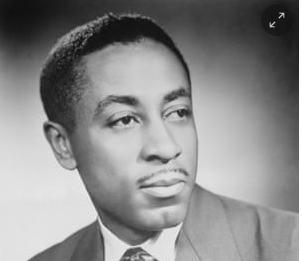
The first black man to sing a leading role on the stage of the Metropolitan Opera was baritone Robert McFerrin. (Yes, folks, he is related to the Bobby McFerrin of “Don’t Worry, Be Happy Fame” — and to the indie singer/songwriter Madison McFerrin, both of whom you can explore on YouTube or Spotify.) McFerrin’s debut followed Marian Anderson’s by a mere three weeks, and unlike Anderson, he was in his vocal prime when Rudolf Bing introduced him to Met audiences, and was given a three-year contract with the company.
McFerrin, the son of a Baptist preacher, was born in Arkansas and raised in Tennessee, where he sang in a gospel choir and in a trio (with two of his seven siblings) that traveled with their father on his preaching tours. Seeking better educational opportunities for him, his parents sent him to live with an aunt and uncle in St. Louis, where his high-school choir director became his mentor, giving him classical training and arranging financial support. McFerrin’s studies at Chicago Musical College were interrupted by a stint in the Army during World War II, but he graduated after his return and moved to New York to pursue a singing career. Congressman Adam Clayton Powell introduced McFerrin to composer/choir director Hall Johnson, who coached him and hired him as soloist for a European tour with the Hall Johnson Choir. McFerrin sang on Broadway (Kurt Weill’s Lost in the Stars) as well as at opera venues including the National Negro Opera Company, City Opera (in William Grant Still’s Troubled Island) and Tanglewood. Despite his resistance, his manager entered him in the Met Auditions of the Air, and he was the first Black artist to win the competition, a victory that brought him a year-long scholarship to study performance skills at the Katherine Turney Long School and led to his Met debut, as Amonasro in 1955. In 1958, he was hired to sing Porgy in the Otto Preminger film of Porgy & Bess. (Sidney Poitier acted the role.) Disappointed with his progress at the Met, where he had sung only three roles, he relocated to Hollywood and opened a voice studio. He later taught at institutions including Sacramento State College, Helskinki’s Sibelius Academy and the St. Louis Institute of Music. Notwithstanding his barrier-breaking Met career, he never got a chance to sing many of the heroic roles he dreamed of, but his success made a mark on singers of the next generation, inspiring them to pursue their own dreams with courage and determination.
In this recording of excerpts from Rigoletto at the Met, McFerrin’s dark-mahogany sound, evenly produced throughout his range, combines with his beautifully controlled use of dynamics, his instinctive rhythmic thrust, and his clear but unfussy diction to create a performance that is as dramatically alive and riveting as it is musically elegant and assured. Under the idiomatic baton of Fausto Cleva, McFerrin rides the ebb and flow of the Verdian vocal line naturally, easily shifting from tender lyricism in the duets with Gilda to blustering rage against the courtiers in “Cortigiani! vil razza dannata,” (31:06). In the scene following Gilda’s seduction, his “La-ra, la-ra”s as he forces himself to resume his jester’s persona while ferreting out clues to Gilda’s fate perfectly project Rigoletto’s mix of furtiveness, false bravado and desperation. At the very end of the opera (51:54), his murmured pleas, begging the dying Gilda not to leave him, are brilliantly understated. Where many baritones use these interjections to grab the spotlight back in the midst of Gilda’s soaring prayer, McFerrin makes them what they are meant to be—involuntary sighs of grief from the depths of his soul.
Bass-baritone William Warfield was another Arkansas-born son of a Baptist minister. His family moved to Rochester, New York, where he was a high-school senior when he won the Music Educators Song Competition, earning him a full scholarship to the Eastman School of Music. His studies, like McFerrin’s were interrupted by Army service during World War II. After his return, he earned his master’s at Eastman and subsequently appeared in the Broadway tour of Call Me Mister and in Marc Blitzstein’s opera Regina, based on The Little Foxes. He too went to Hollywood, making a splash with his performance of “Ol’ Man River” as Joe in the 1951 movie version of Show Boat. He would return to that role often in live performances and recordings. (There is a special resonance, when he sings “Tote dat barge, lift dat bale,” in knowing that Warfield’s grandparents were slaves.) In 1952, a State Department-sponsored tour of Porgy and Bess paired him with Leontyne Price, whom he later married. Faced with rampant discrimination in the opera world, Warfield opted to focus on concert appearances. His recital and oratorio career began with a triumphant Town Hall appearance in 1950 that led to a lengthy tour of Australia. Subsequent concert performances included recordings of Messiah with Eugene Ormandy and Leonard Bernstein, world-premiere performances of Aaron Copland’s Old American Songs and repertory stretching from classic German lieder to Negro Spirituals. Warfield served two terms as president of the National Association of Negro Musicians and worked to preserve the performance tradition of the Spiritual. He was also an admired spoken-word artist, winning a Grammy for his narration of Copland’s Lincoln Portrait. His memoir, My Music and My Life, was published in 1991. Like so many of his Black colleagues, he ended his career as a teacher, at Northwestern University, helping to develop the voices of the future.
Here is Warfield singing “Ol’ Man River” on the Ed Sullivan Show. There’s no need for comment on this performance: it is simply perfect.
For contrast, I’m adding Schubert’s “Glockentürmers Tochterlein” (The Bellringer’s Daughter). The rich, resonance of the lowest notes, the vibrant tone and forthright approach make the narrator’s yearning palpable, and when the lusty, “Ja, ja!”s melt into honeyed diminuendos on “Nur dein” (all yours), the seductive beloved springs to life with equal vividness. There is none of the usual lieder-interpreter’s academic fussiness in Warfield’s performance; he is all flesh and blood, and the music blossoms under his fully human treatment.
Before Warfield’s “Ol Man River, there was Paul Robeson’s, equally perfect and equally admired. Robeson’s life was too rich and complicated for a mini-bio. A true renaissance man, he was a multi-talented athlete (varsity baseball, football, basketball and track!), a scholar (Rutger’s valedictorian and Columbia Law School graduate), a stage actor, a film star, a singer, a linguist, a civil rights activist and one-time NAACP Man of the Year—not bad for the son of a former slave. Finding himself subjected to blatant racism during his brief legal career, he turned his energies to the stage, making his name at home and abroad in roles as diverse as Shakespeare’s Othello, O’Neill’s Emperor Jones and Joe in Kern’s Show Boat. His world travels as a star performer awakened a need to speak out on behalf of oppressed and underrepresented people everywhere, leading to involvement in the Spanish Civil War, Africa’s pursuit of self-determination, India’s independence movement and the Soviet Union’s struggles against Fascism. “The artist must elect to fight for freedom or slavery,” he said. “I have made my choice.” His activism provoked controversy and hostility in the U.S., and he was targeted by the anti-Communist movement and deprived of his passport and the opportunity to make a living abroad. He eventually won his struggle to have his passport returned and celebrated with a triumphant concert at Carnegie Hall, but public opinion had turned against him, and his career never recovered. This thumbnail sketch barely scratches the surface of Robeson’s fascinating life. Anyone who wants to know more can check out the documentary Paul Robeson: Here I Stand.
Here is Robeson singing Mozart’s “O Isis and Osiris” (in English), with his inimitable bottomless, rolling bass. Sarastro, the representation of virtue and rectitude, seems an apt role for the unflinchingly conscientious Robeson. Vocally, the fit is equally perfect: Robeson’s sound is deep and dark but also warm and enveloping. One hears in this commanding voice both unyielding sternness and compassionate love.
And to be fair, here’s Robeson’s “Ol’ Man River.” If it sounds like it could have been written for him, that’s because it was.


Leave a Reply